When people think of puff pastry, they imagine dramatic, sky-high layers of butter and dough.
Traditional puff pastry is beautiful — but it can be intimidating.
That’s where rough puff pastry comes in.
Rough puff pastry is a shortcut version of classic puff pastry.
Instead of preparing a separate détrempe and butter block, the butter is mixed directly into the flour before folding.
The result?
Flaky, buttery layers with about 30% less rise — but significantly less effort.
This is the puff pastry I make most often.
Ingredients
・450 g bread flour
・450 g unsalted butter (cold, cubed)
・1 tsp salt
・225 ml cold water
Make sure all ingredients are well chilled before starting.
Cold weather actually makes puff pastry easier to handle.
How to Make Rough Puff Pastry


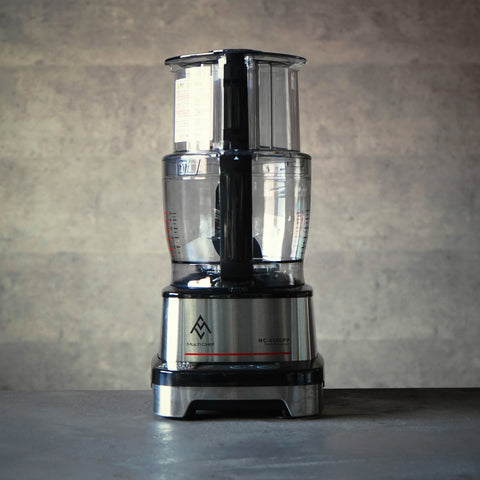
MC-200DFPM / Multi Chef Food Processor
Professional-grade food processor used in this recipe.
View ProductStep 1 – Combine flour and butter
Add flour, salt, and cold butter cubes to a food processor.
Pulse until the butter pieces are about the size of small beans.
Visible butter pieces are essential — do not overmix.
Step 2 – Add water
Add cold water all at once and pulse just until the dough comes together.
Transfer to a lightly floured surface and gently bring the dough together.
Avoid kneading.
Step 3 – Chill
Wrap and refrigerate for at least 1 hour.
Resting allows the gluten to relax and moisture to distribute evenly.
Patience is the key to good puff pastry.

Step 4 – Folding
Roll into a rectangle.
Fold into thirds (like a letter).
Rotate 90 degrees.
Roll again and fold into thirds.
Chill for 30 minutes.
Repeat this process two more times.
Step 5 – Final Use
Roll out into a sheet and use as desired.
Unused dough can be wrapped tightly and frozen.

The charm of rough puff pastry
Rough puff pastry is a simplified version of traditional puff pastry. Instead of enclosing a separate butter block inside the dough, small pieces of butter are mixed directly into the flour and then folded to create layers.
Traditional puff pastry produces dramatic lift and sharply defined layers. Rough puff pastry rises slightly less — about 30% less — but requires fewer steps and is far more consistent to make. If you want maximum height and precision, go with the traditional method. If you value practicality and reliability, rough puff is the better choice.
For storage, the dough can be refrigerated for up to 2 days or frozen for about 2 months. When ready to use, thaw it slowly in the refrigerator. Always wrap the dough tightly to prevent it from drying out.
To avoid common mistakes, keep the butter cold, avoid overmixing, and never skip resting time. Cold butter and patience are what create clean, flaky layers.
This dough works beautifully for both sweet and savory dishes, including meat pies, fruit pies, and tarts.