This store requires javascript to be enabled for some features to work correctly.

Reliable quality, delivered from Japan to the world.
  • Line up
    • Japanese Knife
      • Sashimi knife
      • Deba knife
      • Gyuto
      • Sujihiki
      • Santoku
      • Nakiri
      • Petty knife
      • Honesuki - boning knife
      • Chinese knife
      • Specialized knife
      • Set of knives
      • まな板
    • Frying pan
      • Aluminum frying pan
      • Cast iron frying pan
      • Copper frying pan
      • Stainless steel frying pan
      • Saute pan
      • Tamagoyaki pan
    • Steamer
      • Steamer body
      • Steamer stand
      • Steamer and others
    • Pot
      • Stockpot
      • Saucepan
      • Yukihiranabe
      • Earthenware pot
      • Oyako-nabe (hot pot with eggs)
    • Rice containers and sushi tools
      • Rice container
      • Sushi Utensils
    • Chinese pans and Chinese tools
      • Two-handed wok
      • One-handed Chinese pan
      • Chinese ladle
    • Confectionery and bread making tools
      • Palette
      • Roller
      • Tart mold
    • Cooking utensil
      • Ladle
      • Charcoal stove
      • Strainer
      • Chopsticks / Tongs
      • Lid
      • Basting brush
      • Grater
      • Soft cloth
      • Masher
      • Cooking tray
      • Scourer
      • Other cooking accessories
    • Cooking appliance
      • Food processor
      • Mixer
    • Kiriko
  • Brand
    • SAKAI TAKAYUKI
    • SAKAI KIKUMORI
    • Hoei
    • Ishizuchi kanamono factory
    • Seki Tsubazo
    • Glestain
    • Urushiyama Metal Industry
    • Miyabiurushi Kogei
    • Tanabe kanagu
    • Shimomura Industrial
    • Taniguchi metal
    • KANDA
    • Mine
    • MULCH CHEF
    • KYS
    • EBM
  • Blog
  • Recipe
  • About us
  • Algeria (DZD د.ج)
  • Andorra (EUR €)
  • Argentina (JPY ¥)
  • Australia (AUD $)
  • Azerbaijan (AZN ₼)
  • Bahrain (JPY ¥)
  • Bangladesh (BDT ৳)
  • Barbados (BBD $)
  • Belarus (JPY ¥)
  • Belgium (EUR €)
  • Brazil (JPY ¥)
  • Bulgaria (EUR €)
  • Cambodia (KHR ៛)
  • Canada (CAD $)
  • Chile (JPY ¥)
  • China (CNY ¥)
  • Colombia (JPY ¥)
  • Côte d’Ivoire (XOF Fr)
  • Croatia (EUR €)
  • Cyprus (EUR €)
  • Czechia (CZK Kč)
  • Denmark (DKK kr.)
  • Djibouti (DJF Fdj)
  • Ecuador (USD $)
  • Egypt (EGP ج.م)
  • El Salvador (USD $)
  • Estonia (EUR €)
  • Fiji (FJD $)
  • Finland (EUR €)
  • French Guiana (EUR €)
  • Germany (EUR €)
  • Ghana (JPY ¥)
  • Greece (EUR €)
  • Guadeloupe (EUR €)
  • Guernsey (GBP £)
  • Honduras (HNL L)
  • Hong Kong SAR (HKD $)
  • Hungary (HUF Ft)
  • Iceland (ISK kr)
  • India (INR ₹)
  • Indonesia (IDR Rp)
  • Iraq (JPY ¥)
  • Ireland (EUR €)
  • Italy (EUR €)
  • Jamaica (JMD $)
  • Japan (JPY ¥)
  • Jersey (JPY ¥)
  • Jordan (JPY ¥)
  • Kuwait (JPY ¥)
  • Latvia (EUR €)
  • Lebanon (LBP ل.ل)
  • Liechtenstein (CHF CHF)
  • Lithuania (EUR €)
  • Luxembourg (EUR €)
  • Macao SAR (MOP P)
  • Malaysia (MYR RM)
  • Malta (EUR €)
  • Martinique (EUR €)
  • Mauritius (MUR ₨)
  • Mexico (JPY ¥)
  • Monaco (EUR €)
  • Mongolia (MNT ₮)
  • Morocco (MAD د.م.)
  • Nepal (NPR Rs.)
  • Netherlands (EUR €)
  • New Caledonia (XPF Fr)
  • Nigeria (NGN ₦)
  • Norway (JPY ¥)
  • Oman (JPY ¥)
  • Panama (USD $)
  • Paraguay (PYG ₲)
  • Peru (PEN S/)
  • Poland (PLN zł)
  • Portugal (EUR €)
  • Qatar (QAR ر.ق)
  • Réunion (EUR €)
  • Romania (RON Lei)
  • Rwanda (RWF FRw)
  • San Marino (EUR €)
  • Saudi Arabia (SAR ر.س)
  • Senegal (XOF Fr)
  • Singapore (SGD $)
  • Slovakia (EUR €)
  • Slovenia (EUR €)
  • South Africa (JPY ¥)
  • South Korea (KRW ₩)
  • Spain (EUR €)
  • Sri Lanka (LKR ₨)
  • St. Pierre & Miquelon (EUR €)
  • Sweden (SEK kr)
  • Switzerland (CHF CHF)
  • Taiwan (TWD $)
  • Thailand (THB ฿)
  • Togo (XOF Fr)
  • Trinidad & Tobago (TTD $)
  • Tunisia (JPY ¥)
  • Türkiye (JPY ¥)
  • Uganda (UGX USh)
  • United Arab Emirates (AED د.إ)
  • United States (USD $)
  • Uruguay (UYU $U)
  • Venezuela (USD $)
  • Vietnam (VND ₫)
  • Zimbabwe (USD $)
  • English
  • 日本語
  • Log in
Tomoe-Ya
  • Line up
    • Japanese Knife
      • Sashimi knife
      • Deba knife
      • Gyuto
      • Sujihiki
      • Santoku
      • Nakiri
      • Petty knife
      • Honesuki - boning knife
      • Chinese knife
      • Specialized knife
      • Set of knives
      • まな板
    • Frying pan
      • Aluminum frying pan
      • Cast iron frying pan
      • Copper frying pan
      • Stainless steel frying pan
      • Saute pan
      • Tamagoyaki pan
    • Steamer
      • Steamer body
      • Steamer stand
      • Steamer and others
    • Pot
      • Stockpot
      • Saucepan
      • Yukihiranabe
      • Earthenware pot
      • Oyako-nabe (hot pot with eggs)
    • Rice containers and sushi tools
      • Rice container
      • Sushi Utensils
    • Chinese pans and Chinese tools
      • Two-handed wok
      • One-handed Chinese pan
      • Chinese ladle
    • Confectionery and bread making tools
      • Palette
      • Roller
      • Tart mold
    • Cooking utensil
      • Ladle
      • Charcoal stove
      • Strainer
      • Chopsticks / Tongs
      • Lid
      • Basting brush
      • Grater
      • Soft cloth
      • Masher
      • Cooking tray
      • Scourer
      • Other cooking accessories
    • Cooking appliance
      • Food processor
      • Mixer
    • Kiriko
  • Brand
    • SAKAI TAKAYUKI
    • SAKAI KIKUMORI
    • Hoei
    • Ishizuchi kanamono factory
    • Seki Tsubazo
    • Glestain
    • Urushiyama Metal Industry
    • Miyabiurushi Kogei
    • Tanabe kanagu
    • Shimomura Industrial
    • Taniguchi metal
    • KANDA
    • Mine
    • MULCH CHEF
    • KYS
    • EBM
  • Blog
  • Recipe
  • About us
  • Algeria (DZD د.ج)
  • Andorra (EUR €)
  • Argentina (JPY ¥)
  • Australia (AUD $)
  • Azerbaijan (AZN ₼)
  • Bahrain (JPY ¥)
  • Bangladesh (BDT ৳)
  • Barbados (BBD $)
  • Belarus (JPY ¥)
  • Belgium (EUR €)
  • Brazil (JPY ¥)
  • Bulgaria (EUR €)
  • Cambodia (KHR ៛)
  • Canada (CAD $)
  • Chile (JPY ¥)
  • China (CNY ¥)
  • Colombia (JPY ¥)
  • Côte d’Ivoire (XOF Fr)
  • Croatia (EUR €)
  • Cyprus (EUR €)
  • Czechia (CZK Kč)
  • Denmark (DKK kr.)
  • Djibouti (DJF Fdj)
  • Ecuador (USD $)
  • Egypt (EGP ج.م)
  • El Salvador (USD $)
  • Estonia (EUR €)
  • Fiji (FJD $)
  • Finland (EUR €)
  • French Guiana (EUR €)
  • Germany (EUR €)
  • Ghana (JPY ¥)
  • Greece (EUR €)
  • Guadeloupe (EUR €)
  • Guernsey (GBP £)
  • Honduras (HNL L)
  • Hong Kong SAR (HKD $)
  • Hungary (HUF Ft)
  • Iceland (ISK kr)
  • India (INR ₹)
  • Indonesia (IDR Rp)
  • Iraq (JPY ¥)
  • Ireland (EUR €)
  • Italy (EUR €)
  • Jamaica (JMD $)
  • Japan (JPY ¥)
  • Jersey (JPY ¥)
  • Jordan (JPY ¥)
  • Kuwait (JPY ¥)
  • Latvia (EUR €)
  • Lebanon (LBP ل.ل)
  • Liechtenstein (CHF CHF)
  • Lithuania (EUR €)
  • Luxembourg (EUR €)
  • Macao SAR (MOP P)
  • Malaysia (MYR RM)
  • Malta (EUR €)
  • Martinique (EUR €)
  • Mauritius (MUR ₨)
  • Mexico (JPY ¥)
  • Monaco (EUR €)
  • Mongolia (MNT ₮)
  • Morocco (MAD د.م.)
  • Nepal (NPR Rs.)
  • Netherlands (EUR €)
  • New Caledonia (XPF Fr)
  • Nigeria (NGN ₦)
  • Norway (JPY ¥)
  • Oman (JPY ¥)
  • Panama (USD $)
  • Paraguay (PYG ₲)
  • Peru (PEN S/)
  • Poland (PLN zł)
  • Portugal (EUR €)
  • Qatar (QAR ر.ق)
  • Réunion (EUR €)
  • Romania (RON Lei)
  • Rwanda (RWF FRw)
  • San Marino (EUR €)
  • Saudi Arabia (SAR ر.س)
  • Senegal (XOF Fr)
  • Singapore (SGD $)
  • Slovakia (EUR €)
  • Slovenia (EUR €)
  • South Africa (JPY ¥)
  • South Korea (KRW ₩)
  • Spain (EUR €)
  • Sri Lanka (LKR ₨)
  • St. Pierre & Miquelon (EUR €)
  • Sweden (SEK kr)
  • Switzerland (CHF CHF)
  • Taiwan (TWD $)
  • Thailand (THB ฿)
  • Togo (XOF Fr)
  • Trinidad & Tobago (TTD $)
  • Tunisia (JPY ¥)
  • Türkiye (JPY ¥)
  • Uganda (UGX USh)
  • United Arab Emirates (AED د.إ)
  • United States (USD $)
  • Uruguay (UYU $U)
  • Venezuela (USD $)
  • Vietnam (VND ₫)
  • Zimbabwe (USD $)
  • English
  • 日本語
  • 0
Tomoe-Ya
Search 0 Cart
Home /

Chinese Cleaver: How to Use It and Why It’s Great for Home Cooking

中華包丁の使い方とメリット|使いづらい?危険?家庭でも使いやすい理由

Are Chinese cleavers difficult to use?

When people hear "Chinese cleaver," many probably imagine them to be "heavy," "scary," or "for professionals only."

I certainly felt that way myself at first.

So, let's start by organizing the commonly cited "disadvantages."

■ Heavy

Chinese cleavers are heavier than general kitchen knives. For example, the gyuto (chef's knife) I usually use, with a 210mm blade, weighs about 150g, but a Chinese cleaver of the same 210mm length weighs about 450g. That's roughly three times the weight.
Initially, your wrist might tire easily, and it can feel difficult to handle until you get used to it.

■ Difficult to sharpen

Because the blade is wide and has a large surface area, many people feel it looks "difficult to sharpen." When you actually use it, the larger size makes it harder to maintain a consistent angle, which can be confusing at first. Furthermore, if the blade chips, it's difficult to localize and fix only the chipped part because the blade line of a Chinese cleaver is almost straight; the entire blade needs to be re-shaped. Unlike a santoku knife, which can be easily adjusted by sharpening parts of it, this is a more手間がかかる (time-consuming) aspect.

■ Storage space issues

Due to its large blade, it may not fit into standard knife blocks or storage solutions. In the first place, Japanese kitchens are often not designed with the size of Chinese cleavers in mind, so this is somewhat unavoidable.

■ Difficult to wash

Because the blade is wide, a little extra care is needed when maneuvering it in the sink and when drying.

■ Looks dangerous

Its large size makes it a knife that can feel psychologically "scary." Many people imagine rough uses like pounding and crushing ingredients or making loud noises, and the thought of "what if I cut myself with this..." makes it feel even scarier. The dynamic cooking scenes from Chinese cuisine might also contribute to this image.

Looking at it this way, it might seem difficult to handle,
but using it in practice changes that impression significantly.

Contrary to its appearance, the Chinese cleaver is very practical,
and it is one of the easiest knives to use at home.


What is a Chinese cleaver? A brief explanation of its features

A Chinese cleaver is a knife widely used in Chinese households and by chefs,
characterized by its wide blade, straight blade line, and appropriate weight.

Most are thin, double-beveled blades, designed to slice through vegetables and meat smoothly using the knife's own weight.

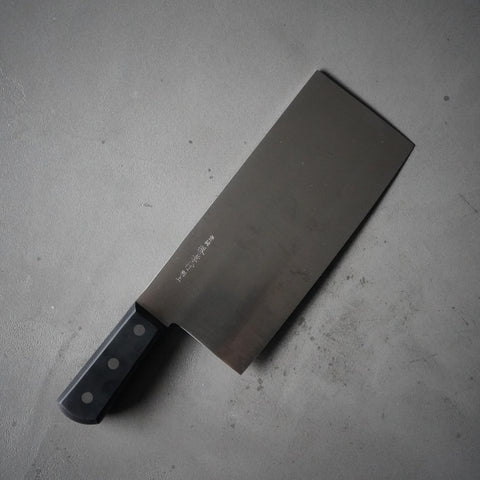
中華包丁

Sakai Takayuki Inox Chinese Cleaver
A Chinese cleaver favored by many professionals

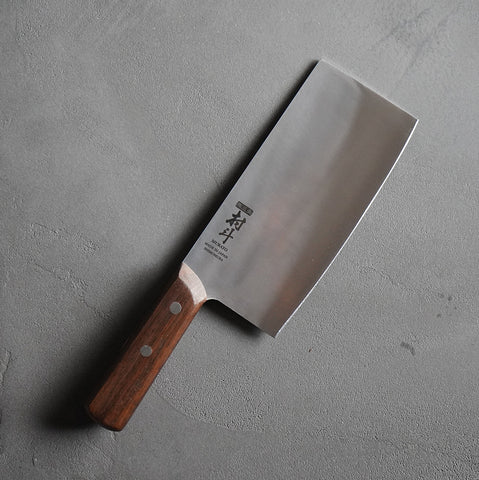
中華包丁

Murato Chinese Cleaver
An easy-to-handle Chinese cleaver for beginners

There are also different types of Chinese cleavers,
and the thin-bladed type (general Chinese cleaver) for vegetables and meat is what's typically used at home.

Detailed usability and benefits will be explained next.


Benefits of Chinese cleavers

■ Cuts effortlessly using its weight

Chinese cleavers are indeed heavy.

However, that weight allows you to slice through ingredients smoothly without needing extra force.

It's about cutting by leveraging the knife's weight,
rather than using brute force.


■ Wide surface, easy to scoop

The wide blade allows you to lift
cut ingredients directly and transfer them to a pot or frying pan.

Just this action alone makes the cooking process significantly smoother.


■ Can crush ingredients

Tasks like crushing garlic or ginger
can be easily done with a Chinese cleaver.

This is also an action possible precisely because of its wide surface.


■ Almost everything can be done with one knife

Since tasks like cutting, scooping, and crushing can all be done with one knife,
there's no need to switch between multiple tools.

The reason Chinese families continue to use just one Chinese cleaver is its inherent efficiency.


Differences from a Santoku knife

Both Santoku knives and Chinese cleavers are "all-purpose," but they excel at slightly different tasks.

■ Benefits of a Santoku knife

・Versatile for meat, fish, and vegetables: Can competently handle most household tasks

・Light and agile: Easy to maneuver, less tiring even during prolonged use

・Good for detailed work: Suitable for peeling, decorative cutting, etc.

・Easy to store: Fits into typical knife blocks

・Easy to wash: Good maneuverability in the sink

■ Benefits of a Chinese cleaver

・Cuts with minimal force: The sensation of the blade sinking in with just a "push" by leveraging its weight

・Cut → gather → transfer as one continuous motion: The wide blade surface links tasks together

・Easy to crush and transport: Smooth for crushing garlic or ginger, and moving ingredients

・Stable for chopping: Straight blade ensures consistent strokes

・Less prone to injury when julienning: The height of the blade allows for easy finger placement, enabling stable chopping

Rather than one being superior to the other,
it's easier to think of the Santoku as "ease of use-oriented" and the Chinese cleaver as "efficiency-oriented".

If you prioritize everyday detailed tasks and maneuverability, a Santoku is suitable; if you want to prepare ingredients in bulk, a Chinese cleaver is more appropriate.


Summary

The Chinese cleaver is a tool that is often misunderstood based solely on its appearance.

However, its shape and weight all have a purpose,
and when you actually use it, you realize how logically designed it is.

Tools always have a reason for being.

And the Chinese cleaver, I believe, is one such tool.

Also explained on Youtube.

Share

Older post

Recent articles
  • Chinese Cleaver: How to Use It and Why It’s Great for Home Cooking
  • My First Experience with a Magewappa Bento Box
  • Introducing the "Madoromu Sake Ware," a MADE IN NIIGATA item.
  • The Charm of Tokoroten: Japan’s Cool Summer Tradition
  • Grilled Unagi: A Traditional Japanese Summer Treat
  • Multi Chef MC-125DMBL Blender Review|Commercial Power You Can Use at Home
  1. Are Chinese cleavers difficult to use?
    1. ■ Heavy
    2. ■ Difficult to sharpen
    3. ■ Storage space issues
    4. ■ Difficult to wash
    5. ■ Looks dangerous
  2. What is a Chinese cleaver? A brief explanation of its features
  3. Benefits of Chinese cleavers
    1. ■ Cuts effortlessly using its weight
    2. ■ Wide surface, easy to scoop
    3. ■ Can crush ingredients
    4. ■ Almost everything can be done with one knife
  4. Differences from a Santoku knife
    1. ■ Benefits of a Santoku knife
    2. ■ Benefits of a Chinese cleaver
  5. Summary
RuffRuff Apps RuffRuff Apps by Tsun

Products featured in this article

  • files/DSC09131-2.jpg

    KD Kanda Chinese cleaver / Kanda

    24,909円(税込)~

  • files/DSC00950.jpg

    Inox Chinese cleaver / Sakai Takayuki

    12,727円(税込)~

  • files/501b0e403753f52b459269bfaec4f61b.jpg

    Murato Chinese Cleaver / Shimomura Industrial

    4,091円(税込)~

  • files/SKK_5bfa29b7-34c2-42f2-a83f-0eb47586095e.jpg

    Chinese Cleaver SKK Vanadium Steel Riveted Handle / Sakai Kikumori

    19,909円(税込)~

ブログ一覧へ

Brandlist

sakaitakayuki knife
ishizuchikanamonofactory

Mail Magazine

Please register to get notifications about new arrivals and other updates.

Item
  • Japanese knife
  • Frying pan
  • Pot
  • Steamer
  • Cooking utensil
  • Others
  • Cooking tray
  • Gift
About
  • About us
  • Blog
  • Recipe
  • News
  • FAQ
  • Contact
Guide
  • Shopping guide
  • International shipping
  • Privacy policy
  • Refund policy
  • Terms of Service
  • Legal notice
  • © 2026, Tomoe-Ya
  • Powered by Shopify
    American Express Apple Pay Google Pay JCB Mastercard PayPal Shop Pay Visa
  • © 2026, Tomoe-Ya
  • Powered by Shopify